Bill 20 Passed. Now Show the Receipts: The K’ómoks Treaty Measurable-Objectives Test
May 30, 2026 · iVoteOneBC research desk
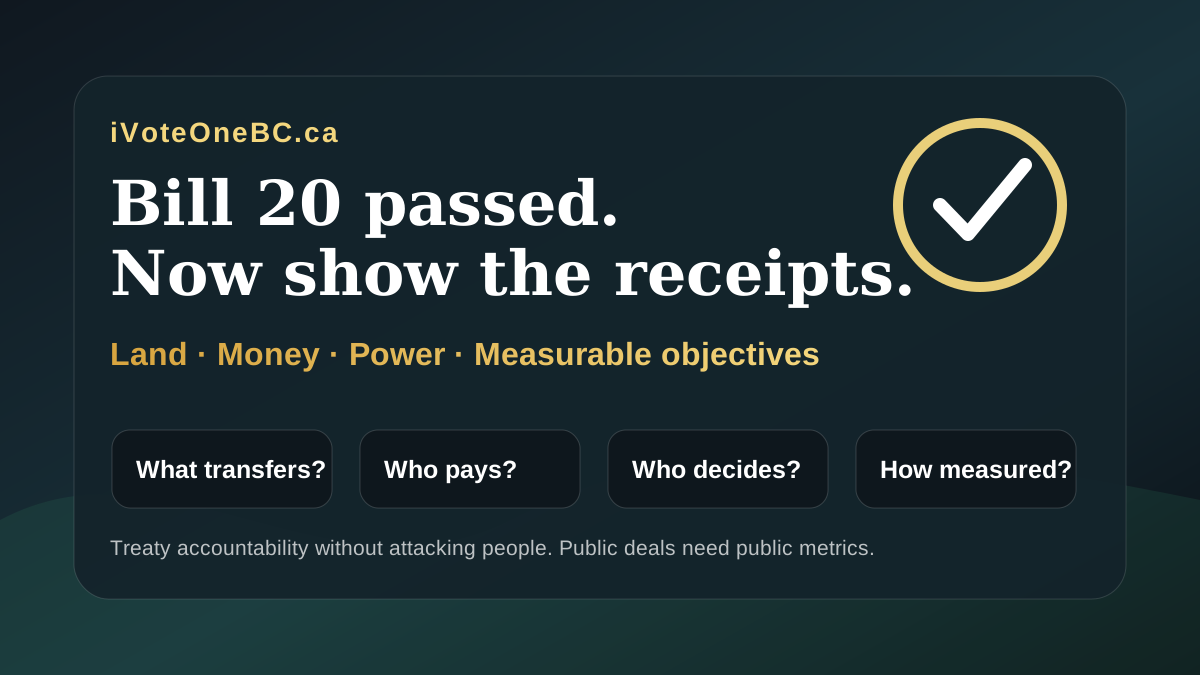
Dallas Brodie’s latest Bill 20 clip lands on the accountability issue the NDP would rather bury: if government is transferring land, money and power, British Columbians deserve measurable objectives — not open-ended language that can never be judged.
The K’ómoks Treaty Act has now passed third reading in the B.C. Legislature. CityNews reported the vote was 53 to 39 on May 28, 2026, and that the treaty still requires federal ratification before it can fully take effect. That makes Brodie’s May 26 exchange more important, not less. The provincial stage may be done. The accountability stage is not.
In the Facebook clip, Brodie argues that Bill 20 transfers major public assets and authority while the supposed common objectives — self-government, self-sufficiency and broader public benefit — are not defined in a way ordinary citizens can measure.
That is the cleanest line of attack.
This debate should not become a personal attack on K’ómoks people. K’ómoks leadership has publicly defended the treaty, says its members gave a democratic mandate, says no private lands are included, and argues the agreement gives legal certainty after decades of negotiation. Those claims should be read and considered fairly.
But a treaty can have supporters and still deserve hard questions. In fact, the bigger the public commitment, the stronger the obligation to publish the metrics.
The standard should be simple: if government says a treaty will create certainty, prosperity, self-government and self-sufficiency, government should define those words before the vote — and measure them after implementation.
The NDP’s treaty language is full of attractive words: certainty, opportunity, governance, prosperity, reconciliation, investment, sustainability. But public policy is not poetry. It is a contract with consequences.
Before federal ratification, British Columbians should be able to see a plain-language scorecard:
- Land: what lands transfer, what future acquisition rights exist, and what public access or local-government implications follow?
- Money: what capital transfers, fiscal financing arrangements, tax powers, implementation costs and long-term obligations are created?
- Power: what law-making authorities apply on treaty lands, and where do provincial, federal and K’ómoks authorities overlap?
- Certainty: which claims are fully settled, which rights continue, and how are neighbouring First Nations’ concerns resolved?
- Self-sufficiency: what measurable indicators will show reduced dependency and stronger local economic capacity?
- Public benefit: what does B.C. receive in return, and how will taxpayers know whether the bargain worked?
If officials cannot answer those questions plainly, the problem is not the public. The problem is the deal.
K’ómoks First Nation has pushed back on what it calls mischaracterizations of the treaty. In an April 30 statement, K’ómoks said UNDRIP references in the treaty are part of a broader interpretive framework and do not require B.C. laws to align with UNDRIP. It also said treaty settlement lands are made up of Crown land and fee-simple lands purchased on a willing-seller, willing-buyer basis, with no private lands included.
Those are important claims. They should be part of the public record.
They also do not end the debate. A government can avoid taking private land and still create major public-policy questions. A treaty can be democratically supported by one nation’s voters and still raise questions for taxpayers, neighbouring First Nations, municipalities and property owners. A “living agreement” can provide flexibility and still create concern if ordinary citizens cannot tell where the boundaries of future obligations lie.
David Eby’s government treats reconciliation files as if intention equals success. Introduce a bill. Stand at a podium. Use the right language. Tell critics they are on the wrong side of history.
But public confidence does not come from ceremonial language. It comes from receipts.
If Bill 20 is a good bargain, the government should welcome a measurable-objectives framework. It should publish baseline data, implementation costs, annual reports, dispute-resolution updates, overlap-claim status and economic outcomes. It should tell taxpayers exactly how the treaty will be judged five, ten and twenty years from now.
Instead, the political pattern is familiar: pass the framework first, ask the public to trust the process, and treat accountability as negativity.
That is why Brodie’s exchange matters. She is forcing the missing question into the room: how will anyone know whether this worked?
OneBC can now turn Bill 20 into a broader treaty-accountability standard for British Columbia:
- No major treaty implementation without a public, plain-language cost-and-power summary.
- No vague “common objectives” without measurable targets and deadlines.
- No claim of “certainty” without clear answers on neighbouring First Nations, municipalities, taxpayers and property owners.
- No open-ended living agreement without scheduled public reviews and legislative reporting.
- No moral shield for government. Respecting Indigenous people does not require suspending scrutiny of politicians.
That last point matters most. This is not about attacking K’ómoks citizens. It is about refusing to let the NDP transfer land, money and authority while hiding behind words nobody can audit.
Bottom line: Bill 20 passed the Legislature. Now Victoria should publish the receipts: what transfers, who pays, who decides, what is settled, and what numbers prove success.
- Dallas Brodie / Facebook video, May 26, 2026: Bill 20 K’ómoks Treaty Act exchange
- CityNews Vancouver, May 28, 2026: K’ómoks Treaty Act passes in B.C. legislature
- B.C. Government, April 14, 2026: K’ómoks Treaty legislation introduced
- Legislative Assembly of B.C.: Bill 20 — K’ómoks Treaty Act
- K’ómoks First Nation, April 30, 2026: Response to mischaracterizations of Treaty Act Bill 20
This article is political commentary on public legislation and treaty accountability. It does not attack Indigenous people or deny Aboriginal rights. It argues that large public commitments should include clear, measurable outcomes and transparent reporting.