OneBC Puts Merit Hiring Back on the Healthcare Agenda
May 19, 2026 · iVoteOneBC research desk
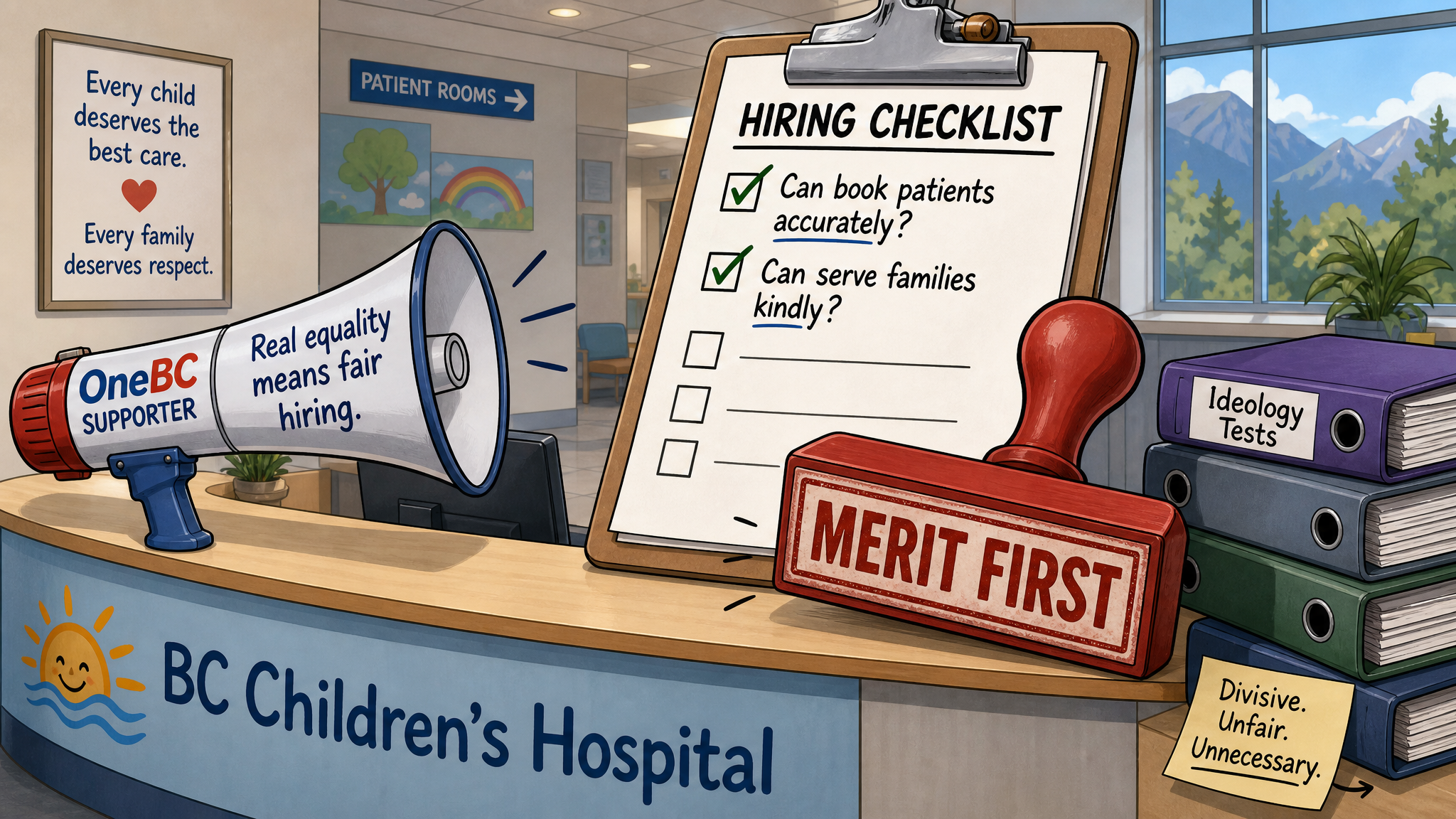
OneBC’s newest public message cuts to a question many British Columbians understand immediately: in healthcare, should hiring start with competence, patient service and fairness — or with ideological language that ordinary applicants may see as a political test?
On May 19, OneBC quoted an X post showing screenshots of a Provincial Health Services Authority job posting for a Registration/Booking Clerk, Immunization Clinic — BC Children’s Hospital. The posting shown in the screenshots lists ordinary clerical requirements — Grade 12 plus two years of recent related experience, or an equivalent combination — but also includes broad language about knowledge of settler colonialism, systemic racism, Indigenous-specific racism, Indigenous Cultural Safety, UNDRIP, DRIPA-related commitments and “equity-deserving” groups.
OneBC’s response was blunt: hire for merit, not “Land Back ideology.” That is a political judgment, not a neutral finding — but it points to a real public-sector accountability issue.
The fair question
No serious person should want rude, culturally insensitive or discriminatory healthcare service. A hospital booking clerk should treat every family with patience, dignity and respect. If training helps staff serve Indigenous patients, newcomers, seniors, parents and children better, that can be legitimate.
But public hiring standards should also be clear, job-related and equal. For a frontline administrative role, the core test should be whether the applicant can book patients accurately, protect privacy, communicate clearly, handle pressure, and serve families fairly. If political or ideological frameworks are treated as mandatory qualifications, government employers should explain why they are necessary for the job and how applicants with different lawful views are treated.
Questions PHSA should be able to answer
- Which listed ideological or policy commitments are mandatory qualifications, and which are training expectations after hiring?
- How are applicants assessed on phrases like “settler colonialism,” “systemic racism,” and “equity-deserving groups”?
- Could a qualified applicant who supports equal treatment but disagrees with activist policy language still be hired?
- Are these requirements standard across clerical healthcare postings, or specific to this role?
- How does PHSA ensure hiring remains merit-based and non-discriminatory for all applicants?
Why OneBC can own this lane
This is where OneBC’s message is strongest. The party does not need to exaggerate or invent numbers. It can point to public documents and say: British Columbians want hospitals that work, clinics that answer phones, appointments that get booked, and staff hired because they are good at the job.
That is a positive equality argument. Real equality means the public service belongs to everyone — Indigenous and non-Indigenous, immigrant and Canadian-born, religious and secular, left and right. Nobody should have to recite fashionable political language to serve the public well.
Dallas Brodie and OneBC have been building a broader case against government overreach in DRIPA, property rights, education and healthcare. This PHSA posting gives supporters another concrete example to track: not as an attack on individual workers, but as a demand that public institutions keep hiring standards practical, fair and tied to service.
Bottom line: British Columbia needs healthcare competence first. Cultural respect matters. Equal treatment matters. But ideology should never outrank merit when families are waiting for care.